The 4 Kinds of AI Agent (and Where Your Business Actually Is)
Key Takeaway: Every AI helper your business could use fits on one map with two questions: does it know you, and does it act on its own? That gives you four kinds of agent: the plain chatbot, the assistant that knows you, the scheduled worker, and the advanced agent. Most owners are still in the first square. The good news: the next square over is one file away, and each square you move multiplies what the last one was worth.
Pin Yourself on This Map
"Agent" might be the most abused word in AI right now. Everything gets called one, from a chat window to science fiction. So I drew the map I wish someone had handed me, and I use it to explain where any business actually stands:
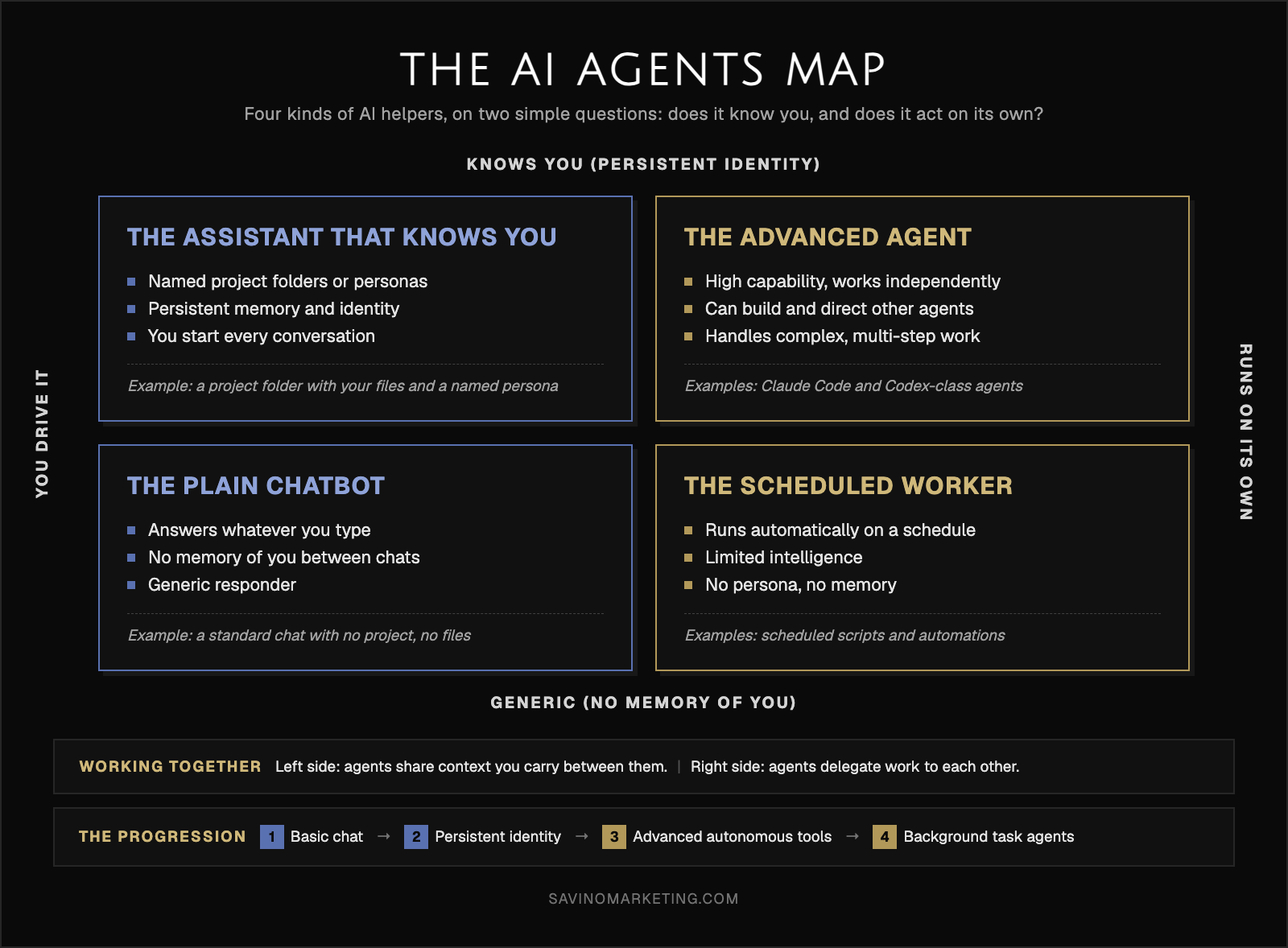
Two questions sort everything out:
- Does it know you? Does the AI carry a persistent memory of your business, your voice, and your rules, or does every conversation start with a stranger?
- Does it act on its own? Do you drive every interaction, or can it do work without you in the room?
Four combinations, four kinds of agent. Here is each one in plain English, and who it is really for.
The Plain Chatbot (It Forgets You, You Drive It)
This is ChatGPT or Claude in a bare window: you type, it answers, the tab closes, and everything about you evaporates. It is a generic responder, brilliant at general questions and blank on your business.
Nothing is wrong with this square. It is where everyone starts, and it is genuinely useful from day one. The problem is staying here: owners re-introduce their business a hundred times, get generic answers back, and conclude AI is overrated. The tool was never the ceiling. The missing memory was.
The Assistant That Knows You (It Knows You, You Drive It)
Same tools, one change: the AI now starts every conversation already knowing who you are. A project folder holds your files, a me.md identity file says who you are and how you want to be advised, and suddenly the answers come back in your voice, respecting your rules, aware of your prices and your customers.
You still start every conversation. But you never introduce yourself again, and the quality jump is bigger than any model upgrade. For a lot of small businesses, a salon, a solo trade, a small shop, this square alone changes the week, and honestly, some owners never need to leave it. That is not falling behind. That is the right tool at the right size.
The Scheduled Worker (It Forgets You, It Runs Alone)
Bottom-right: automations that run on a clock without you. A script that emails you yesterday's numbers every morning. A reminder that fires when an invoice ages past thirty days. Set it, and it runs.
These are dependable and dumb, no persona, no memory, no judgment, and that is fine, because their job is rhythm, not thinking. Most businesses already live in this square without calling it AI: every autoresponder and recurring report is a scheduled worker. The trap is expecting intelligence from them; they execute, they do not decide.
The Advanced Agent (It Knows You, It Runs Alone)
Top-right, where the word "agent" earns its name: AI that carries deep context about your business AND works independently. It handles multi-step jobs, checks its own output, and can even direct other agents, one researching while another drafts while a third reviews. Tools in the class of Claude Code and Codex live here.
This is how my own setup runs: named agents, each reading the same private folder, doing real work while I do something else. Two honest caveats, though. First, this square rests entirely on the two below it: an autonomous agent with no memory of your business is just a fast stranger making confident mistakes, and the thing that feeds these agents the right context at the right time is the meaning-based search over my files. Second, you do not need this square to win. It is the deep end, not the goal line.
So Where Are You, and What Is Next?
Read the map bottom-left to top-right and it becomes a path:
- Basic chat. You are using AI bare. Fine, everyone starts here.
- Persistent identity. One folder and one file, and every tool knows your business. This step is nearly free and pays the biggest single jump.
- Advanced autonomous tools. Agents that do multi-step work with you steering.
- Background task agents. Work happens while you sleep.
To be precise about the map: steps 3 and 4 are both the top-right square, first with you steering, then running in the background. And if you already have autoresponders, you own the bottom-right square, but it does not move you along this path: those workers have no memory of you, and memory is what the path builds on.
Most owners I talk to are on step 1 and assume step 4 is for tech companies. The honest read: step 2 is one afternoon, it is a folder of text files, and each step multiplies the value of the one before it, because the memory you build in step 2 is exactly what steps 3 and 4 run on.
If you want to make that climb with a guide instead of alone, that is precisely what Own Your AI is: nine weeks, one on one, where we stand up your memory layer in the first three weeks and then build a working system on top of it, one that keeps running after the nine weeks end, because you run it. The application is short and the fit call is honest.
Joseph Philip Savino is the founder of Savino Marketing, based in Hazlet, NJ. He teaches startups and small businesses to adopt AI safely. If you want a working AI system inside your business in 9 weeks, built with you so you own it, apply to Own Your AI. The fit call is where we decide honestly whether it is right for you.
Want More Insights?
Want to go deeper than the blog? Own Your AI, my 9-week 1:1 program, is where I teach this hands-on today, and The Vibe Circle, my AI community, opens in 2027.